
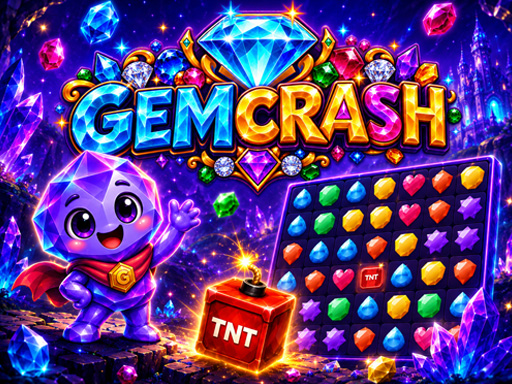
GEMCRASH is a colorful match-three puzzle journey in which Gemik crosses a crystal kingdom one objective-based level at a time. This guide uses only behavior visible in the current browser build and the publisher description. The live build displayed a chapter map, level progression, stars, a fortune reward, and a perk interface before entering the puzzle grid. Open GEMCRASH beside this guide so GEMCRASH can confirm each route, control, and recovery rule through actual play.
The title, description, instructions, thumbnail, and iframe came from the GameMonetize newest HTML5 publisher feed. The GEMCRASH iframe returned HTTP 200 without frame-blocking headers, and Chromium reached an interactive screen before publication. That check establishes that GEMCRASH is available for browser play; this guide then focuses on repeatable decisions rather than unsupported claims.
Read the Level Before Moving
Name the Current Objective
In GEMCRASH, the current focus is the displayed color, obstacle, score, or board-area objective. For GEMCRASH, use this method: Stating the displayed color, obstacle, score, or board-area objective before the first input. GEMCRASH checks the result before the next input and preserves the position when the evidence is unclear.
Scan the Complete Play Area
In GEMCRASH, the current focus is the lower rows, blocked corners, isolated target gems, and possible four- or five-piece patterns. For GEMCRASH, use this method: Examining the lower rows, blocked corners, isolated target gems, and possible four- or five-piece patterns. GEMCRASH checks the result before the next input and preserves the position when the evidence is unclear.
Build a Reliable Opening
Choose a Repeatable Route
In GEMCRASH, the current focus is a bottom-up sequence that advances the objective while allowing gravity to create useful cascades. For GEMCRASH, use this method: Planning a bottom-up sequence that advances the objective while allowing gravity to create useful cascades. GEMCRASH checks the result before the next input and preserves the position when the evidence is unclear.
Protect the Fallback
In GEMCRASH, the current focus is spending limited moves on decorative clears that never reach the hardest target area. For GEMCRASH, use this method: Identifying how to avoid spending limited moves on decorative clears that never reach the hardest target area. GEMCRASH checks the result before the next input and preserves the position when the evidence is unclear.
Manage the Important Resources
Spend Only for the Objective
In GEMCRASH, the current focus is remaining moves, special gems, open target lanes, fortune rewards, and optional perks. For GEMCRASH, use this method: Counting remaining moves, special gems, open target lanes, fortune rewards, and optional perks. GEMCRASH checks the result before the next input and preserves the position when the evidence is unclear.
Use Strong Effects Deliberately
In GEMCRASH, the current focus is a four-match, five-match, line clear, area clear, or color effect whose coverage reaches the objective. For GEMCRASH, use this method: Waiting for a four-match, five-match, line clear, area clear, or color effect whose coverage reaches the objective. GEMCRASH checks the result before the next input and preserves the position when the evidence is unclear.
Control the Action Sequence
Make One Confirmed Action
In GEMCRASH, the current focus is swap one adjacent gem to form a horizontal or vertical line of at least three matching pieces. For GEMCRASH, use this method: Using the core action to swap one adjacent gem to form a horizontal or vertical line of at least three matching pieces. GEMCRASH checks the result before the next input and preserves the position when the evidence is unclear.
Keep Inputs Deliberate
In GEMCRASH, the current focus is click and drag toward an adjacent gem on desktop, or tap and swipe one tile on touch devices. For GEMCRASH, use this method: Click and drag toward an adjacent gem on desktop, or tap and swipe one tile on touch devices. GEMCRASH checks the result before the next input and preserves the position when the evidence is unclear.
Recover From a Failed Attempt
Find the First Error
In GEMCRASH, the current focus is stop after the cascade, rescan the entire board, and use one central setup move instead of forcing an isolated edge match. For GEMCRASH, use this method: Reviewing the first moment where the safe plan changed, then stop after the cascade, rescan the entire board, and use one central setup move instead of forcing an isolated edge match. GEMCRASH checks the result before the next input and preserves the position when the evidence is unclear.
Change One Variable
In GEMCRASH, the current focus is spending limited moves on decorative clears that never reach the hardest target area. For GEMCRASH, use this method: Changing only one choice connected to spending limited moves on decorative clears that never reach the hardest target area. GEMCRASH checks the result before the next input and preserves the position when the evidence is unclear.
Practice With Evidence
Repeat a Controlled Test
In GEMCRASH, the current focus is replay an early chapter level, compare the first five moves, and preserve the opening that clears the difficult region sooner. For GEMCRASH, use this method: Replay an early chapter level, compare the first five moves, and preserve the opening that clears the difficult region sooner. GEMCRASH checks the result before the next input and preserves the position when the evidence is unclear.
Record the Proven Sequence
In GEMCRASH, the current focus is complete the stated target before the move counter reaches zero and return to the chapter map with a route worth repeating. For GEMCRASH, use this method: Writing down the shortest reliable sequence that can complete the stated target before the move counter reaches zero and return to the chapter map with a route worth repeating. GEMCRASH checks the result before the next input and preserves the position when the evidence is unclear.
Decision Review
Check Twelve Decisions
- GEMCRASH states the objective before GEMCRASH moves; GEMCRASH checks the result, and GEMCRASH keeps the evidence for the next attempt.
- GEMCRASH scans the full area before GEMCRASH commits; GEMCRASH protects a fallback, and GEMCRASH keeps the evidence for the next attempt.
- GEMCRASH chooses one route while GEMCRASH avoids competing plans; GEMCRASH keeps the next step visible, and GEMCRASH keeps the evidence for the next attempt.
- GEMCRASH counts the limiting resource before GEMCRASH spends it; GEMCRASH preserves what is not needed, and GEMCRASH keeps the evidence for the next attempt.
- GEMCRASH uses a strong effect only when GEMCRASH reaches the goal; GEMCRASH can verify its coverage, and GEMCRASH keeps the evidence for the next attempt.
- GEMCRASH makes one input while GEMCRASH waits for feedback; GEMCRASH prevents accidental overlap, and GEMCRASH keeps the evidence for the next attempt.
- GEMCRASH stops at safe ground before GEMCRASH looks ahead; GEMCRASH separates planning from execution, and GEMCRASH keeps the evidence for the next attempt.
- GEMCRASH names the first error when GEMCRASH fails; GEMCRASH changes the connected cause, and GEMCRASH keeps the evidence for the next attempt.
- GEMCRASH repeats a stable opening while GEMCRASH tests one variable; GEMCRASH compares equivalent attempts, and GEMCRASH keeps the evidence for the next attempt.
- GEMCRASH records a proven sequence after GEMCRASH succeeds; GEMCRASH turns success into a reusable route, and GEMCRASH keeps the evidence for the next attempt.
- GEMCRASH uses controls deliberately so GEMCRASH remains readable; GEMCRASH can recover after pressure, and GEMCRASH keeps the evidence for the next attempt.
- GEMCRASH finishes the objective only when GEMCRASH has confirmed the exit; GEMCRASH brings the plan to completion, and GEMCRASH keeps the evidence for the next attempt.
Next Session Checklist
Make the Next Attempt Measurable
Before opening GEMCRASH, choose one outcome to measure. Let GEMCRASH show the full level, state the displayed color, obstacle, score, or board-area objective, and scan the lower rows, blocked corners, isolated target gems, and possible four- or five-piece patterns. Build a bottom-up sequence that advances the objective while allowing gravity to create useful cascades, protect against spending limited moves on decorative clears that never reach the hardest target area, and count remaining moves, special gems, open target lanes, fortune rewards, and optional perks. Use this action: swap one adjacent gem to form a horizontal or vertical line of at least three matching pieces. If the plan changes, apply this recovery: stop after the cascade, rescan the entire board, and use one central setup move instead of forcing an isolated edge match. Repeat this practice: replay an early chapter level, compare the first five moves, and preserve the opening that clears the difficult region sooner. Finish only when the route can complete the stated target before the move counter reaches zero and return to the chapter map with a route worth repeating. Return to GEMCRASH with one documented correction, and let GEMCRASH test that correction under the same conditions. A measured GEMCRASH session produces a specific lesson even when the level is not completed, while an unplanned GEMCRASH restart usually repeats the same hidden error. GEMCRASH.