

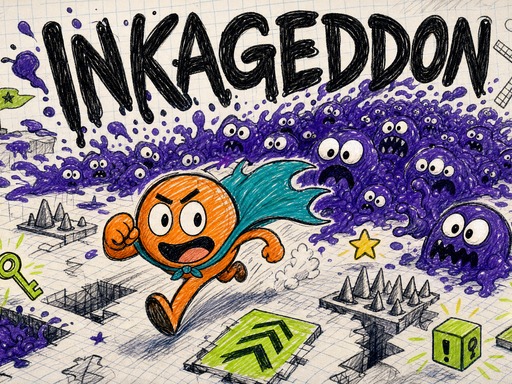
Inkageddon works best when every attempt begins with one observable objective. Inkageddon is a doodle survival battle across five notebook worlds: Fresh Page, Graph Paper, Sticky Note, Blueprint, and Midnight Chalk. Each world has its own boss. Players choose among three heroes and assemble a run from six weapons that can merge through tier three and reveal secret evolutions. Ink blots, mites, and highlighter hornets form the enemy roster. Collected Ink can be banked for permanent shop upgrades, while 12 badges and a Codex add lasting goals. Chill, Normal, and Nightmare offer three difficulty settings, and a seeded Daily Doodle provides another repeatable challenge. Movement and dashing begin immediately, keeping the focus on survival and weapon growth.
The verified input guidance is equally important: Click with the mouse or tap to begin. Move with WASD, the arrow keys, or by dragging, as listed in the description. Press Space or tap to dash away from danger. The source does not specify separate keys for firing, merging weapons, opening the shop, or pausing, so none is added here.
This guide separates visible facts from assumptions, so Inkageddon players can compare equivalent attempts, locate the first wrong decision, and improve one variable at a time.
Keep the playable page open while reading, test each recommendation against the live build, and let Inkageddon provide the final evidence whenever the game state changes.
Source note: Inkageddon game facts and embed availability were verified against the GameMonetize newest HTML5 publisher feed on 2026-10-04. Strategy recommendations are HeyFun editorial analysis.
Inkageddon: Understand the Play Loop
Inkageddon: Identify the Immediate Objective
Inkageddon turns Identify the Immediate Objective into a specific checkpoint: name the desired result, inspect the available space, and wait until the next input has a clear purpose. After each Inkageddon attempt, record the first decision that reduced control, choose one correction for Identify the Immediate Objective, and test that correction under similar conditions.
Inkageddon: Separate Evidence From Assumptions
Inkageddon turns Separate Evidence From Assumptions into a specific checkpoint: name the desired result, inspect the available space, and wait until the next input has a clear purpose. After each Inkageddon attempt, record the first decision that reduced control, choose one correction for Separate Evidence From Assumptions, and test that correction under similar conditions.
Inkageddon: Read the Full Play Area
Inkageddon: Map Hazards and Useful Space
Inkageddon turns Map Hazards and Useful Space into a specific checkpoint: name the desired result, inspect the available space, and wait until the next input has a clear purpose. After each Inkageddon attempt, record the first decision that reduced control, choose one correction for Map Hazards and Useful Space, and test that correction under similar conditions.
Inkageddon: Protect a Recovery Route
Inkageddon turns Protect a Recovery Route into a specific checkpoint: name the desired result, inspect the available space, and wait until the next input has a clear purpose. After each Inkageddon attempt, record the first decision that reduced control, choose one correction for Protect a Recovery Route, and test that correction under similar conditions.
Inkageddon: Build a Reliable Opening
Inkageddon: Choose a Conservative First Action
Inkageddon turns Choose a Conservative First Action into a specific checkpoint: name the desired result, inspect the available space, and wait until the next input has a clear purpose. After each Inkageddon attempt, record the first decision that reduced control, choose one correction for Choose a Conservative First Action, and test that correction under similar conditions.
Inkageddon: Repeat the Same Starting Sequence
Inkageddon turns Repeat the Same Starting Sequence into a specific checkpoint: name the desired result, inspect the available space, and wait until the next input has a clear purpose. After each Inkageddon attempt, record the first decision that reduced control, choose one correction for Repeat the Same Starting Sequence, and test that correction under similar conditions.
Inkageddon: Control Every Input
Inkageddon: Apply the Verified Controls
Inkageddon turns Apply the Verified Controls into a specific checkpoint: name the desired result, inspect the available space, and wait until the next input has a clear purpose. After each Inkageddon attempt, record the first decision that reduced control, choose one correction for Apply the Verified Controls, and test that correction under similar conditions.
Inkageddon: Match Input Length to Feedback
Inkageddon turns Match Input Length to Feedback into a specific checkpoint: name the desired result, inspect the available space, and wait until the next input has a clear purpose. After each Inkageddon attempt, record the first decision that reduced control, choose one correction for Match Input Length to Feedback, and test that correction under similar conditions.
Inkageddon: Manage Risk and Resources
Inkageddon: Take Rewards With a Purpose
Inkageddon turns Take Rewards With a Purpose into a specific checkpoint: name the desired result, inspect the available space, and wait until the next input has a clear purpose. After each Inkageddon attempt, record the first decision that reduced control, choose one correction for Take Rewards With a Purpose, and test that correction under similar conditions.
Inkageddon: Keep a Safety Margin
Inkageddon turns Keep a Safety Margin into a specific checkpoint: name the desired result, inspect the available space, and wait until the next input has a clear purpose. After each Inkageddon attempt, record the first decision that reduced control, choose one correction for Keep a Safety Margin, and test that correction under similar conditions.
Inkageddon: Recover From Failed Attempts
Inkageddon: Find the First Broken Decision
Inkageddon turns Find the First Broken Decision into a specific checkpoint: name the desired result, inspect the available space, and wait until the next input has a clear purpose. After each Inkageddon attempt, record the first decision that reduced control, choose one correction for Find the First Broken Decision, and test that correction under similar conditions.
Inkageddon: Change Only One Variable
Inkageddon turns Change Only One Variable into a specific checkpoint: name the desired result, inspect the available space, and wait until the next input has a clear purpose. After each Inkageddon attempt, record the first decision that reduced control, choose one correction for Change Only One Variable, and test that correction under similar conditions.
Inkageddon: Develop Advanced Consistency
Inkageddon: Increase Pace After Control
Inkageddon turns Increase Pace After Control into a specific checkpoint: name the desired result, inspect the available space, and wait until the next input has a clear purpose. After each Inkageddon attempt, record the first decision that reduced control, choose one correction for Increase Pace After Control, and test that correction under similar conditions.
Inkageddon: Compare Equivalent Runs
Inkageddon turns Compare Equivalent Runs into a specific checkpoint: name the desired result, inspect the available space, and wait until the next input has a clear purpose. After each Inkageddon attempt, record the first decision that reduced control, choose one correction for Compare Equivalent Runs, and test that correction under similar conditions.
Inkageddon: Prepare the Next Session
Inkageddon: Review the Proven Route
Inkageddon turns Review the Proven Route into a specific checkpoint: name the desired result, inspect the available space, and wait until the next input has a clear purpose. After each Inkageddon attempt, record the first decision that reduced control, choose one correction for Review the Proven Route, and test that correction under similar conditions.
Inkageddon: Set One Measurable Goal
Inkageddon turns Set One Measurable Goal into a specific checkpoint: name the desired result, inspect the available space, and wait until the next input has a clear purpose. After each Inkageddon attempt, record the first decision that reduced control, choose one correction for Set One Measurable Goal, and test that correction under similar conditions.
Final Session Checklist
Use this checklist before the next run. Each item gives Inkageddon a measurable purpose instead of relying on a lucky result.
- Inkageddon: state the immediate objective before the first input.
- Inkageddon: scan the complete play area before choosing a route.
- Inkageddon: keep one safe recovery option visible.
- Inkageddon: use the verified control for a named purpose.
- Inkageddon: compare timing and position after every state change.
- Inkageddon: protect progress before chasing an optional reward.
- Inkageddon: identify the first mistake rather than the final animation.
- Inkageddon: change one variable on the next comparable attempt.
- Inkageddon: increase pace only after two stable openings.
- Inkageddon: finish with one written goal for the next session.
Open Inkageddon with one objective and one recovery plan. Inkageddon should begin with a complete scan, continue through deliberate inputs, and pause briefly whenever the state changes. A useful Inkageddon session is not merely a lucky finish; it is a route that can be explained, repeated, and improved.