
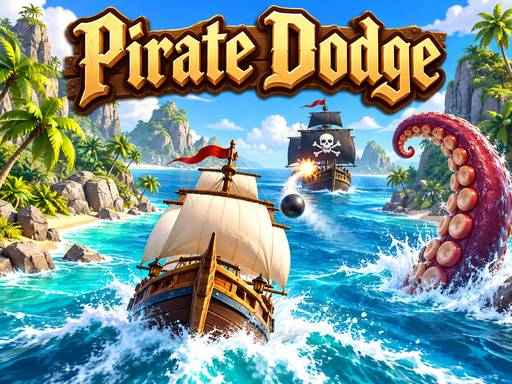
Pirate Dodge works best when every attempt begins with one observable objective. Pirate Dodge sends a tiny boat down a narrow river where rocks, kraken tentacles, and hostile ships crowd every lane. Survival depends on moving between lanes at the right moment while watching how each enemy behaves. Some pirate vessels fire at the player, while others cross the route and force a quick change of position. The boat can return fire whenever an opening appears. Defeated pirates leave coins and fragments of an old map, giving successful runs a clear reward beyond simply staying afloat. Collected coins can purchase a faster and more dangerous ship, so careful dodging and accurate shots gradually improve the equipment available for later journeys along the river.
The verified input guidance is equally important: On PC, use Left and Right or A and D to change river lanes, press Space to fire, and press P to pause. On mobile, tap the left or right side of the screen or swipe to switch lanes, then tap the Fire control to shoot at pirate ships.
This guide separates visible facts from assumptions, so Pirate Dodge players can compare equivalent attempts, locate the first wrong decision, and improve one variable at a time.
Keep the playable page open while reading, test each recommendation against the live build, and let Pirate Dodge provide the final evidence whenever the game state changes.
Source note: Pirate Dodge game facts and embed availability were verified against the GameMonetize newest HTML5 publisher feed on 2026-10-04. Strategy recommendations are HeyFun editorial analysis.
Pirate Dodge: Understand the Play Loop
Pirate Dodge: Identify the Immediate Objective
Pirate Dodge turns Identify the Immediate Objective into a specific checkpoint: name the desired result, inspect the available space, and wait until the next input has a clear purpose. After each Pirate Dodge attempt, record the first decision that reduced control, choose one correction for Identify the Immediate Objective, and test that correction under similar conditions.
Pirate Dodge: Separate Evidence From Assumptions
Pirate Dodge turns Separate Evidence From Assumptions into a specific checkpoint: name the desired result, inspect the available space, and wait until the next input has a clear purpose. After each Pirate Dodge attempt, record the first decision that reduced control, choose one correction for Separate Evidence From Assumptions, and test that correction under similar conditions.
Pirate Dodge: Read the Full Play Area
Pirate Dodge: Map Hazards and Useful Space
Pirate Dodge turns Map Hazards and Useful Space into a specific checkpoint: name the desired result, inspect the available space, and wait until the next input has a clear purpose. After each Pirate Dodge attempt, record the first decision that reduced control, choose one correction for Map Hazards and Useful Space, and test that correction under similar conditions.
Pirate Dodge: Protect a Recovery Route
Pirate Dodge turns Protect a Recovery Route into a specific checkpoint: name the desired result, inspect the available space, and wait until the next input has a clear purpose. After each Pirate Dodge attempt, record the first decision that reduced control, choose one correction for Protect a Recovery Route, and test that correction under similar conditions.
Pirate Dodge: Build a Reliable Opening
Pirate Dodge: Choose a Conservative First Action
Pirate Dodge turns Choose a Conservative First Action into a specific checkpoint: name the desired result, inspect the available space, and wait until the next input has a clear purpose. After each Pirate Dodge attempt, record the first decision that reduced control, choose one correction for Choose a Conservative First Action, and test that correction under similar conditions.
Pirate Dodge: Repeat the Same Starting Sequence
Pirate Dodge turns Repeat the Same Starting Sequence into a specific checkpoint: name the desired result, inspect the available space, and wait until the next input has a clear purpose. After each Pirate Dodge attempt, record the first decision that reduced control, choose one correction for Repeat the Same Starting Sequence, and test that correction under similar conditions.
Pirate Dodge: Control Every Input
Pirate Dodge: Apply the Verified Controls
Pirate Dodge turns Apply the Verified Controls into a specific checkpoint: name the desired result, inspect the available space, and wait until the next input has a clear purpose. After each Pirate Dodge attempt, record the first decision that reduced control, choose one correction for Apply the Verified Controls, and test that correction under similar conditions.
Pirate Dodge: Match Input Length to Feedback
Pirate Dodge turns Match Input Length to Feedback into a specific checkpoint: name the desired result, inspect the available space, and wait until the next input has a clear purpose. After each Pirate Dodge attempt, record the first decision that reduced control, choose one correction for Match Input Length to Feedback, and test that correction under similar conditions.
Pirate Dodge: Manage Risk and Resources
Pirate Dodge: Take Rewards With a Purpose
Pirate Dodge turns Take Rewards With a Purpose into a specific checkpoint: name the desired result, inspect the available space, and wait until the next input has a clear purpose. After each Pirate Dodge attempt, record the first decision that reduced control, choose one correction for Take Rewards With a Purpose, and test that correction under similar conditions.
Pirate Dodge: Keep a Safety Margin
Pirate Dodge turns Keep a Safety Margin into a specific checkpoint: name the desired result, inspect the available space, and wait until the next input has a clear purpose. After each Pirate Dodge attempt, record the first decision that reduced control, choose one correction for Keep a Safety Margin, and test that correction under similar conditions.
Pirate Dodge: Recover From Failed Attempts
Pirate Dodge: Find the First Broken Decision
Pirate Dodge turns Find the First Broken Decision into a specific checkpoint: name the desired result, inspect the available space, and wait until the next input has a clear purpose. After each Pirate Dodge attempt, record the first decision that reduced control, choose one correction for Find the First Broken Decision, and test that correction under similar conditions.
Pirate Dodge: Change Only One Variable
Pirate Dodge turns Change Only One Variable into a specific checkpoint: name the desired result, inspect the available space, and wait until the next input has a clear purpose. After each Pirate Dodge attempt, record the first decision that reduced control, choose one correction for Change Only One Variable, and test that correction under similar conditions.
Pirate Dodge: Develop Advanced Consistency
Pirate Dodge: Increase Pace After Control
Pirate Dodge turns Increase Pace After Control into a specific checkpoint: name the desired result, inspect the available space, and wait until the next input has a clear purpose. After each Pirate Dodge attempt, record the first decision that reduced control, choose one correction for Increase Pace After Control, and test that correction under similar conditions.
Pirate Dodge: Compare Equivalent Runs
Pirate Dodge turns Compare Equivalent Runs into a specific checkpoint: name the desired result, inspect the available space, and wait until the next input has a clear purpose. After each Pirate Dodge attempt, record the first decision that reduced control, choose one correction for Compare Equivalent Runs, and test that correction under similar conditions.
Pirate Dodge: Prepare the Next Session
Pirate Dodge: Review the Proven Route
Pirate Dodge turns Review the Proven Route into a specific checkpoint: name the desired result, inspect the available space, and wait until the next input has a clear purpose. After each Pirate Dodge attempt, record the first decision that reduced control, choose one correction for Review the Proven Route, and test that correction under similar conditions.
Pirate Dodge: Set One Measurable Goal
Pirate Dodge turns Set One Measurable Goal into a specific checkpoint: name the desired result, inspect the available space, and wait until the next input has a clear purpose. After each Pirate Dodge attempt, record the first decision that reduced control, choose one correction for Set One Measurable Goal, and test that correction under similar conditions.
Final Session Checklist
Use this checklist before the next run. Each item gives Pirate Dodge a measurable purpose instead of relying on a lucky result.
- Pirate Dodge: state the immediate objective before the first input.
- Pirate Dodge: scan the complete play area before choosing a route.
- Pirate Dodge: keep one safe recovery option visible.
- Pirate Dodge: use the verified control for a named purpose.
- Pirate Dodge: compare timing and position after every state change.
- Pirate Dodge: protect progress before chasing an optional reward.
- Pirate Dodge: identify the first mistake rather than the final animation.
- Pirate Dodge: change one variable on the next comparable attempt.
- Pirate Dodge: increase pace only after two stable openings.
- Pirate Dodge: finish with one written goal for the next session.
Open Pirate Dodge with one objective and one recovery plan. Pirate Dodge should begin with a complete scan, continue through deliberate inputs, and pause briefly whenever the state changes. A useful Pirate Dodge session is not merely a lucky finish; it is a route that can be explained, repeated, and improved.